


What is RPL? Why should chefs consider RPL in Australia?
In the skilled worker immigration and employment pathway to Australia, one of the biggest obstacles for Vietnamese chefs is the lack of Australian-standard vocational qualifications. Many applicants have worked in kitchens for 5-10 years, even managing kitchens, but lack equivalent certifications within the Australian vocational training system.
That’s why RPL – Recognition of Prior Learning – becomes a key solution.
👉 What is RPL?
RPL (Recognition of Prior Learning) is a form of recognition of previous work and study experience, allowing applicants to convert their practical experience into Australian vocational qualifications without having to start learning from scratch.
For the culinary industry, RPL is not just a certificate, but a mandatory foundation for:
Taking a Skill Assessment
Applying for an Australian Skilled Worker Visa
Getting professional competence recognized by Australian businesses
What is RPL for chefs in the Australian vocational training system?
RPL – Standardized Experience According to Australian Standards
Unlike typical “experience verification,” the RPL in Australia’s Vocational Education and Training (VET) system is conducted by:
Registered Training Organisations (RTOs) licensed by the Australian Government
Assessment based on the Australian Qualification Framework (AQF)
Culinary candidates will be comprehensively assessed on:
Professional skills
Commercial kitchen work processes
Food safety and hygiene
Organizational, coordination, and quality control abilities
The final result is a legally recognized Australian vocational certificate, valid nationally and internationally.
Who is suitable for the RPL culinary qualification?
The RPL culinary qualification is not for those without prior experience. This program is suitable for:
Chefs currently working in restaurants, hotels, and resorts
Candidates working in European, Asian, pastry, and bakery cuisine
Individuals with 2-3 years or more of practical experience
Candidates aiming to immigrate to Australia under a skilled worker visa or permanent residency
📌 No requirements:
Must have attended an Australian vocational school
Must be currently residing in Australia
Must have a university degree
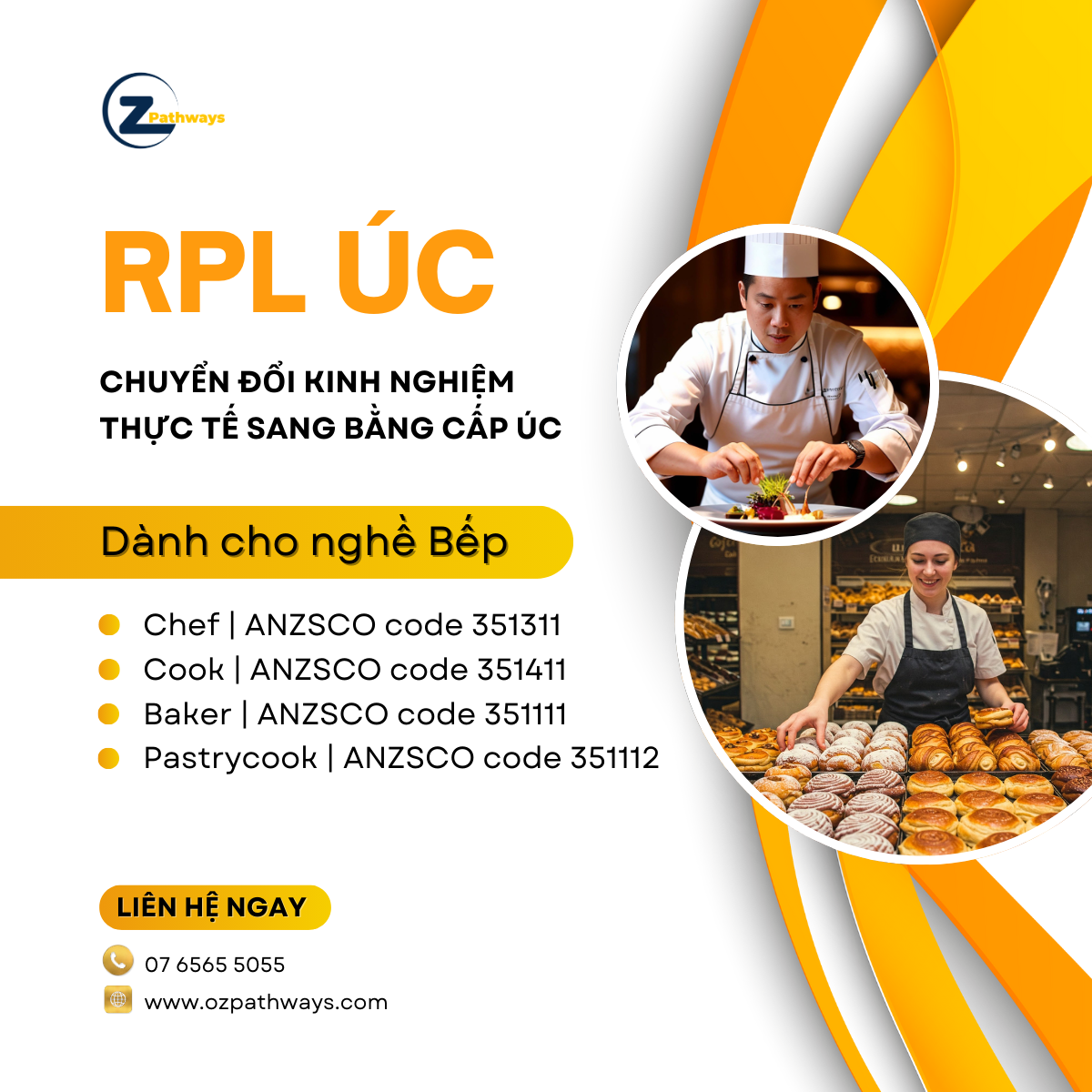
The following culinary occupation codes apply: RPL according to ANZSCO
In the Australian immigration system, occupations are defined by the ANZSCO Code. The RPL (Regional Planning and Proposition) for culinary professions currently applies to the following occupation codes:
🔹 Chef – ANZSCO 351311
Suitable for head chefs, sous chefs, and head chefs.
Requires diverse cooking experience, menu planning, and kitchen management.
🔹 Cook – ANZSCO 351411
Suitable for chefs directly working in the kitchen.
Focuses on food preparation in a commercial environment.
🔹 Baker – ANZSCO 351111
Bread and pastry making.
Working in bakeries, hotels, and pastry chains.
🔹 Pastrycook – ANZSCO 351112
Sweet cakes, desserts, and pastries.
Requires advanced pastry techniques.
👉 Identifying the correct occupation code from the start is crucial to:
Avoid Skill Assessment rejection
Avoid going in the wrong direction for visa applications
What are the benefits of the RPL for culinary professions? 1. Converting Experience into Legally Valid Australian Qualifications
You don’t start learning from scratch; instead, you use your existing experience to:
Receive Australian Certificate III/IV
Be recognized throughout the Australian work permit system
2. A Required Foundation for Skill Assessment
For culinary professions:
Australian qualifications + experience = core requirements for Skill Assessment
Skill Assessment is a mandatory step before a skilled visa
3. Open a Clear Australian Visa Pathway
After RPL, applicants can pursue the following paths:
Visa 482 – Temporary Skill Shortage
Visa 494 – Skilled Employer Sponsored Regional
Visa 186 – Employer Nomination Scheme
How does the RPL process for culinary professions work?
A standard, legally compliant RPL process in Australia typically includes:
Step 1: Initial Qualification Assessment
Reviewing experience
Comparing with ANZSCO occupation codes
Determining RPL eligibility and visa
Step 2: Document Collection and Standardization
RPL documents usually include:
Culinary CV
Employment contract/experience confirmation
Photos and videos of actual work
Payslips and work schedules (if available)
Step 3: Practical Assessment
Observing practical kitchen skills
Assessing kitchen processes, safety, and organization
Professional interview (if needed)
Theory test
Step 4: Issuance of Australian Vocational Certificate
Certificate issued by RTO Australia
Has a unique, traceable code
Ready for Skill Assessment and Visa
Does the RPL for culinary skills require an exam?
👉 No academic-style exam required. RPL focuses on:
Assessing practical skills
Observing skills and work processes
Verifying experience to be accurate, sufficient, and genuine
For candidates with many years of experience in the kitchen, RPL is usually much easier than retraining.
Oz Pathways – The RPL program for culinary professionals in Vietnam
In March 2026, Oz Pathways will launch the RPL program for culinary professionals in Ho Chi Minh City, accepting applications in batches.
What support does Oz Pathways provide to candidates?
✅ Initial RPL eligibility assessment (free)
✅ Assessment: determining suitability and which occupation code to pursue
✅ Support throughout the entire RPL process
✅ Career path guidance for culinary professionals – Skill Assessment – Australian Visa
Frequently Asked Questions about RPL for Culinary Professionals (FAQ)
What is RPL? Is it legal?
RPL is a form of experience recognition authorized by the Australian Government and implemented by a legally recognized RTO.
Can I apply for an RPL without a Vietnamese vocational certificate?
👉 Yes, if you have practical work experience.
How long does an RPL for a culinary career take?
The timeframe depends on the application, usually 2–4 months.
Conclusion: RPL – The foundation for a culinary career and Australian visa.
If you are currently a chef: