
 Vietnamese
Butchery is a skilled trade sector involving the cutting, trimming, preparation, processing, and handling of meat for retail, restaurants, supermarkets, food processing facilities, and food production businesses. According to Australia’s official occupational classification, Butcher or Smallgoods Maker – ANZSCO 351211 belongs to the Butchers and Smallgoods Makers occupation group. Key duties may include selecting, cutting, trimming, and preparing meat for sale or supply, as well as operating meat processing and smallgoods production equipment.
If you have hands-on experience in butcher shops, supermarkets, food processing facilities, meat factories, or roles related to meat cutting and meat preparation, this may be a valuable employment sector to consider when exploring a suitable career pathway in Australia. The official occupation description also includes tasks such as boning, trimming fat, cutting, mincing, marinating, curing, and operating mincers, mixers, sausage-making machines, and other relevant processing equipment.
Oz HR & Migration focuses on connecting candidates with suitable Butchery job opportunities in Australia. We also support candidates in preparing their application profile and understanding the basic requirements before applying.
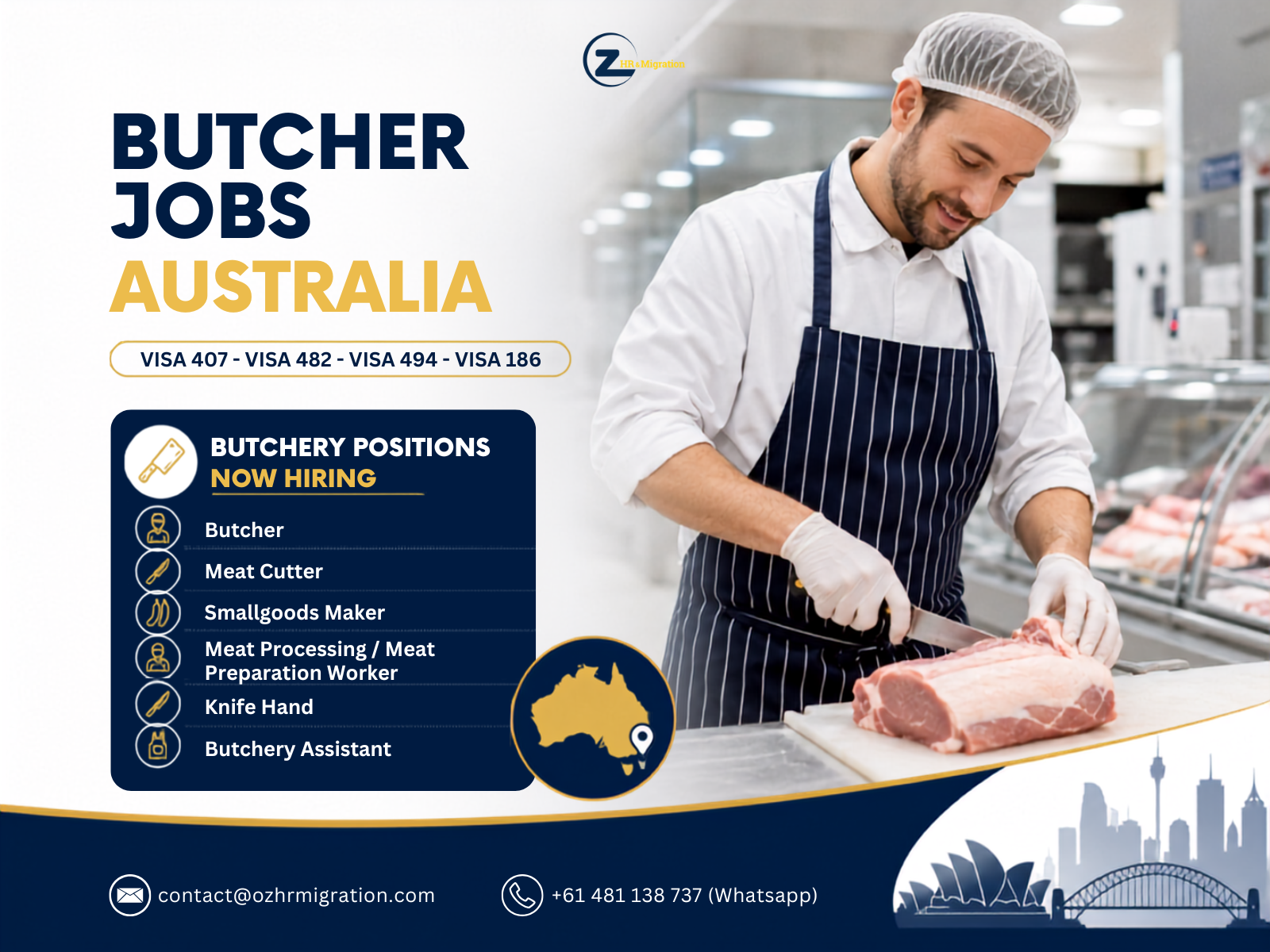
Depending on the recruitment needs of each employer in Australia, Butchery-related positions may include:
Among these roles, Butcher or Smallgoods Maker is an official occupation under Australia’s ANZSCO system and is currently included on the Core Skills Occupation List. This makes it a notable occupation within the skilled trade group related to meat processing and preparation.

Depending on the specific role, candidates in the Butchery sector may be responsible for a variety of hands-on duties aligned with Australia’s official occupation description.
🔪
Cutting, trimming, portioning, and preparing meat according to requirements
🦴
Removing bones, trimming fat, mincing, or grinding meat
🌿
Marinating, seasoning, curing, or preparing smallgoods products
⚙️
Using professional knives and meat processing equipment including mincers, mixers, and sausage-making machines
📦
Packaging, storing, and arranging meat products for sale or supply
✅
Following food safety, hygiene, and workplace procedures
Butchery job opportunities in Australia may be available across different work environments. Candidates are not limited to traditional butcher shop roles.
This means candidates are not limited to traditional butcher shop environments. They may also explore opportunities in food processing and production businesses that require suitable skilled workers.
To access Butchery job opportunities in Australia, candidates should generally demonstrate the following:
💪
Experience in butchery, meat cutting, meat processing, or food preparation environments.
🔪
Safe and proficient use of professional knives and meat processing equipment.
🧼
Basic knowledge of food safety, hygiene standards, and workplace procedures.
🏋️
Suitable physical fitness to work shifts or in food production environments.
🎯
A stable, careful, and process-oriented working attitude valued by employers.
🗣️
English proficiency suitable for the role or related visa pathway requirements.
🎓
Relevant vocational qualifications or certificates are an advantage where available.
According to ANZSCO, Butchers and Smallgoods Makers is classified at Skill Level 3 — generally equivalent to an AQF Certificate III (with at least 2 years on-the-job training) or AQF Certificate IV. In some cases, at least 3 years of relevant work experience may substitute for formal qualifications. For the 482 Core Skills stream, at least 1 year of relevant work experience is required.
Depending on the job position, work location, and the candidate’s individual profile, some Hospitality opportunities may be related to:
407
Workplace-Based Occupational Training
Allows a stay in Australia for up to 2 years for workplace-based training in a nominated occupation.
482
Temporary Skill Shortage
For eligible positions sponsored by an Australian employer. Occupation must be on the CSOL with relevant experience.
494
Employer-Sponsored Regional
For employer-sponsored positions in regional areas of Australia, with potential permanent residency pathway.
186
Employer Nomination Scheme
A permanent residency pathway for skilled workers nominated by an eligible Australian employer.
Not every Butchery position comes with sponsorship. The most suitable visa pathway will depend on the specific job position, employer, work location, experience, qualifications, English ability, skills assessment requirements if applicable, and migration conditions at the time of assessment.
The Australian Department of Home Affairs also states that the 482 visa is designed to address labour shortages when an employer cannot find a suitably skilled Australian worker, while the 494 visa is an employer-sponsored pathway for regional areas.
To improve the chance of being assessed as suitable for Butchery positions in Australia, candidates should prepare:
For skilled trade roles, the clearer the profile is in showing practical experience, knife skills, previous work environments, and specific duties performed, the easier it is for employers to review and assess the candidate.
For candidates in the Butchery sector, Oz HR & Migration provides support in:
We focus on a practical, clear, and selective approach. The goal of Oz HR & Migration is to help candidates access job opportunities in Australia in a serious and suitable way, aligned with actual recruitment demand.
If you have experience in butchery, meat cutting, meat processing, or other roles related to meat handling and preparation, you can submit your details for Oz HR & Migration to review your profile and support you in exploring suitable opportunities.